Dive Brief:
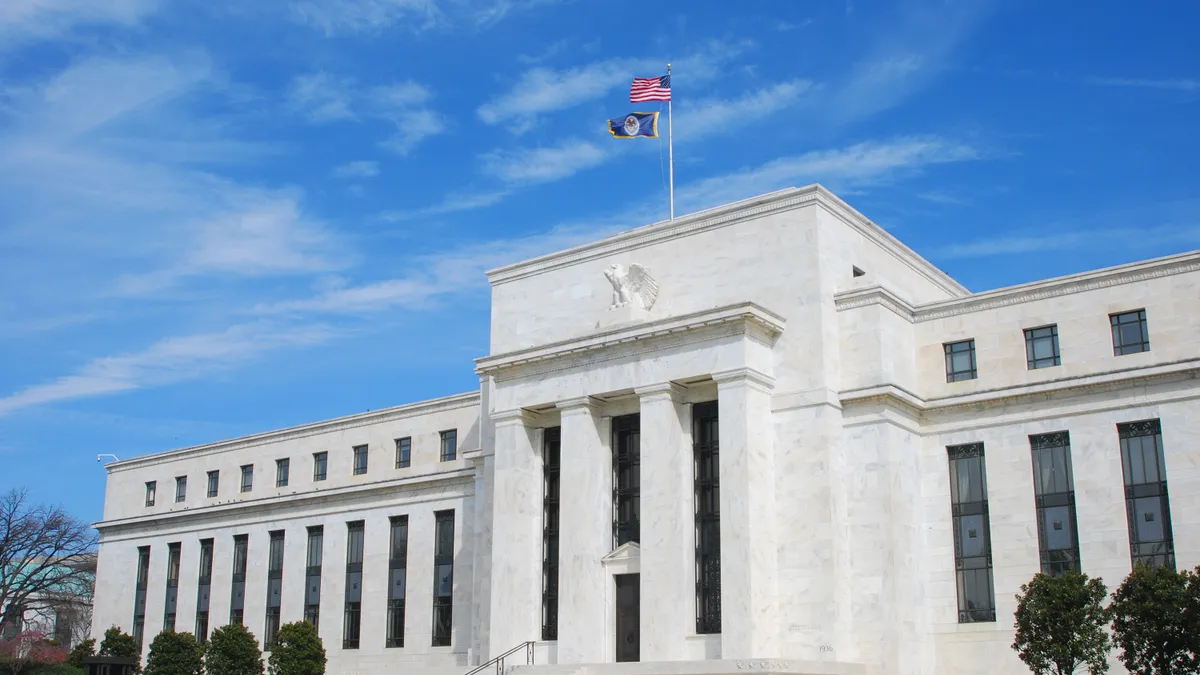
- The Federal Open Market Committee held the federal funds rate steady at 3.5% to 3.75% at its March meeting on Wednesday.
- After multiple cuts last year, this is the second straight meeting where the Fed maintained current rates. Stephen I. Miran, who was appointed to the board by President Donald Trump, was the only member of the committee seeking a cut, asking for a quarter-point reduction.
- Federal Reserve Chair Jerome Powell said in a news conference on Wednesday that individual FOMC participants were asked to write down the appropriate federal funds rate under what they see as the most likely scenario for the economy. The median participant projects the rate to be 3.4% at the end of this year and 3.1% at the end of next year.
Dive Insight:
While the Fed said “economic activity has been expanding at a solid pace,” job gains have remained low and the unemployment rate has changed little in recent months. Inflation, which the FOMC seeks to contain at 2%, remains somewhat elevated.
The Fed expects real GDP to rise 2.4% this year and 2.3% next year, which is stronger than expected in December. It expects unemployment to be at 4.4% at the end of the year before edging down.
“Job gains have remained low,” Powell said in a news conference on Wednesday. “A good part of the slowing in the pace of job growth over the past year reflects a decline in the growth of the labor force due to lower immigration and labor force participation.”
Powell said the implications of developments in the Middle East for the U.S. economy are uncertain, though they weren’t the only driver of inflation.
“Near-term measures of inflation expectations have risen in recent weeks, likely reflecting the substantial rise in oil prices caused by the supply disruptions in the Middle East,” Powell said. “Most measures of longer-term expectations remain consistent with our 2% inflation goal.”
George Ratiu, the vice president of research at the National Apartment Association, said the Fed “finds itself squeezed between the proverbial rock and hard place,” as “oil shock-induced stagflation” emerges as a threat.
“Moderating economic momentum, marked by a weakening job market and consumer optimism, is running headlong into rising inflation,” Ratiu told Multifamily Dive in emailed comments. “Any rate cuts aimed at warming up the deflating economic balloon risk fanning the flame of rebounding inflation, further squeezing the very consumers it means to help and clamping down on their spending.”
However, last year's rate cuts from the Fed have not translated into lower interest rates, according to Ratiu. “The bond market, which drives interest rates for home loans, has been pricing the increased geopolitical volatility, with the 10-year Treasury rising well-above 4.0% and pushing the 30-year fixed mortgage rate back over 6.0%,” he told Multifamily Dive.
Rental housing owners also seem to understand the Fed’s dilemma, even if they would prefer a return to the days of lower borrowing costs.
“As a real estate owner, I certainly would like to see lower interest rates,” Arn Cenedella, owner of Spark Multifamily Investment Group in Greenville, South Carolina, told Multifamily Dive in emailed comments. “That being said, we are getting mixed signals both about the strength of the economy and the future trend of inflation. I believe this uncertainty provides the Fed some justification for doing nothing at this time.”
Click here to sign up to receive multifamily and apartment news like this article in your inbox every weekday.