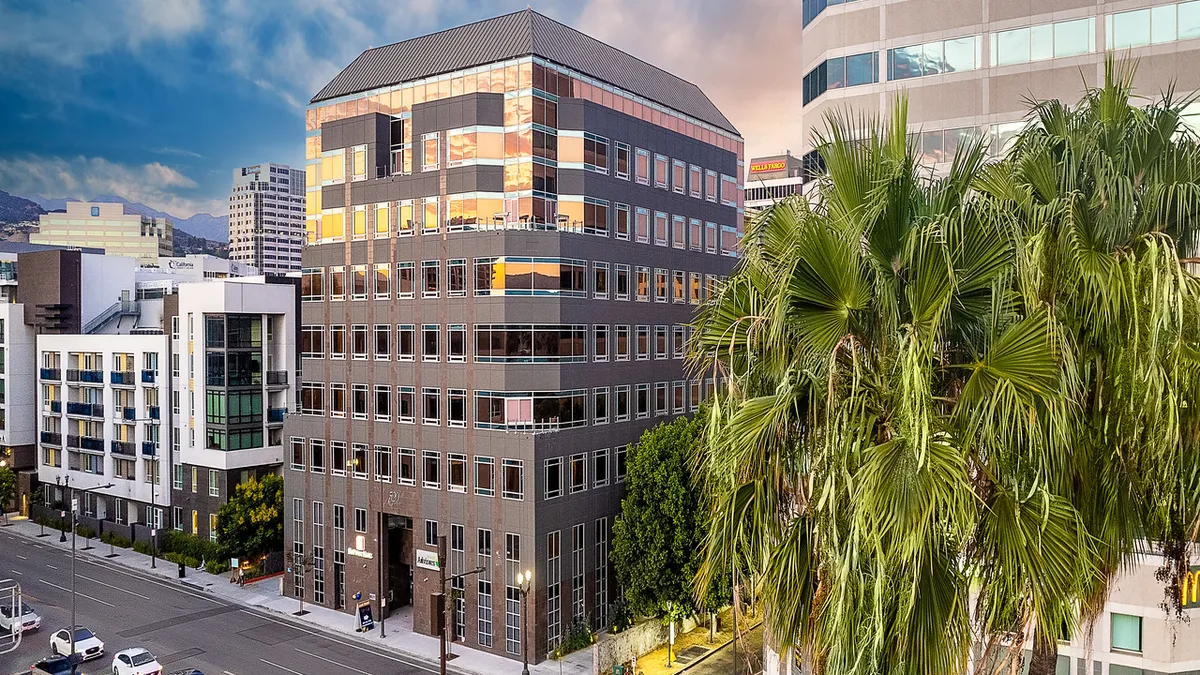
The urgency to rethink the use of office space has never been greater. With office vacancy rates increasing substantially in the wake of the COVID-19 pandemic and the housing shortage intensifying, apartment conversions have been on a historic rise for several years. Gensler called adaptive reuse the new standard in its 2026 design forecast.
California’s office market experienced one of the largest post-pandemic demand shocks in the country, with San Francisco and Los Angeles among the most challenged markets. San Francisco saw a 32.8% office vacancy rate at the end of 2025, according to CBRE, while Los Angeles stood at 25.1%.
In this environment, policymakers across California have been pursuing policy changes that remove barriers to converting older commercial buildings into housing.
One of the most recent local initiatives is in Los Angeles. In February, the Los Angeles City Council adopted a Citywide Adaptive Reuse Ordinance that established zoning incentives and streamlined procedures to convert existing commercial buildings and structures into five or more residential units.
“Los Angeles seized on adaptive reuse as a core strategy of its adopted Housing Element Rezoning Program, which started with stakeholder outreach in 2023,” a spokesperson for the Los Angeles City Planning office said in an email.
Under the new ARO, all buildings at least 15 years old are now eligible for conversion if they are located in multifamily residential, commercial, parking or public facilities zones. Parking structures or parking areas within an existing building that may be obsolete are also eligible for conversion.
“If you dial back the clock to the late ’90s when the first adaptive reuse ordinance came out, it transformed a lot of old bank buildings and commercial spaces into downtown’s first wave of residential development,” said Nella McOsker, president and CEO of the Central City Association of Los Angeles.
“You fast forward to now and we’re looking at a very different set of buildings — tall, enormous skyscrapers — and that’s a different kind of policy problem to solve.”
Mixed impact from housing policy changes
Although Los Angeles has expanded its adaptive reuse framework, additional incentives and policy adjustments may still be needed to unlock more conversions, according to McOsker.
“There’s a great new update to the adaptive reuse citywide ordinance that’s really permissive,” she said. “But when you think about continuing to streamline building code and the layers of how the state is approaching this, L.A. still needs to spur more of these conversions in places where we know it’s viable.”
In 2022, the state passed Assembly Bill 2011 and Senate Bill 6 to permit residential development in certain commercially zoned areas. However, Caroline Chase, partner at the Los Angeles-based real estate law firm Allen Matkins, said these laws have produced limited results so far due in part to labor stipulations.
“AB 2011, which was amended by AB 2243, has changed the legal landscape by creating a ministerial (i.e., no CEQA) approval pathway for qualifying housing development projects along commercial corridors, even if the property is not zoned for residential use,” Chase said. “In exchange, the developer must provide on-site affordable housing and meet specified labor requirements, the latter of which has often been a deal-breaker for developers.”
A February 2005 report published by YIMBY Law found that in 2024 only eight AB 2011 projects were approved statewide, while no projects were approved using SB 6, which includes even more labor requirements.
Other state policies have had a direct effect on the feasibility of adaptive reuse projects, particularly parking reforms tied to transit-oriented development, Nolan Gray, senior director of legislation and research at California YIMBY.
“The main law that has helped with adaptive reuse has been AB 2097, which exempted development from parking requirements within a half mile of major transit stops,” said Gray. “A huge issue in historic downtowns is insufficient on-site parking.”
Conversions can make economic sense
A 2023 report by SPUR and the Urban Land Institute San Francisco estimated that conversion projects, including labor and materials, cost between $472,000 and $633,000 per unit, not including seismic upgrades that may be required when converting older commercial structures.
Charles Bloszies, a San Francisco-based architect and structural engineer who has worked on several major conversions in the city, said economics still remains the biggest barrier to making conversions work.
“SB 6 has had little impact on San Francisco development because almost all zoning districts allow residential development,” he said. “AB 2011 applies to 100% affordable housing, which San Francisco needs, but most developers cannot ‘pencil out’ 100% affordable housing due to high construction costs.”
Conversions in San Francisco often remain stubbornly infeasible due to various factors, including high construction costs, challenges related to building in dense urban landscapes, seismic upgrade code requirements and strong union labor mandates.
Still, he remains hopeful that new financing mechanisms and targeted incentives could help unlock more projects.
“The latest creation of a downtown revitalization district includes funding for projects via tax increment financing,” Bloszies said. “This could be the tipping point needed to cause developers to move ahead with conversion projects.”
Click here to sign up to receive multifamily and apartment news like this article in your inbox every weekday.